PPB to PPM Calculator
Understanding Concentration Units: What is PPB & What is PPM?
Both PPB (Parts Per Billion) and PPM (Parts Per Million) are dimensionless scientific concentration units used across environmental testing, chemistry, and industrial hygiene to measure trace quantities of substances in water, air, and soil.
What is PPB (Parts Per Billion)?
PPB stands for Parts Per Billion. It represents one unit of a solute or contaminant per one billion units of the total solution or mixture.
What is PPM (Parts Per Million)?
PPM stands for Parts Per Million. It represents one unit of a solute or contaminant per one million units of the total solution or mixture.
PPB to PPM Conversion Formula Explained
The ppb to ppm formula uses a single conversion factor. To convert parts per billion to parts per million, divide by 1,000. To convert ppm to ppb, multiply by 1,000. Both formulas are derived from the metric system, where 1 billion is 1,000 times 1 million.
The ppb to ppm equation divides by 1,000 because 1 ppm contains 1,000 ppb.
The ppm to ppb equation multiplies by 1,000 to reverse the unit conversion.
Scientific Notation Form
In scientific notation, 1 ppm = 10⁻⁶ and 1 ppb = 10⁻⁹. The conversion factor between the two concentration units is 10³ (1,000). The National Institute of Standards and Technology (NIST) recommends expressing trace amounts using SI-compatible notation, where ppb equals micrograms per liter (µg/L) in water and ppm equals milligrams per liter (mg/L) in water.
PPB and PPM in Environmental and Laboratory Testing
PPB and ppm are the 2 primary concentration units in environmental monitoring and laboratory analysis. The Environmental Protection Agency (EPA) sets Maximum Contaminant Levels (MCLs) in ppb for drinking water pollutants. The World Health Organization (WHO) publishes global water quality guidelines using both ppb and ppm. The Occupational Safety and Health Administration (OSHA) establishes permissible exposure limits for workplace air quality in ppm and ppb.
PPB to PPM in Water Quality Testing
Water quality laboratories measure dissolved contaminant levels using ppb (equivalent to µg/L or micrograms per liter) and ppm (equivalent to mg/L or milligrams per liter). The EPA sets these Maximum Contaminant Levels for U.S. drinking water:
Analytical instruments for water testing include mass spectrometry (MS) and gas chromatography (GC). These techniques detect contaminants at sub-ppb detection limits, measuring trace analysis concentrations below 1 µg/L.
PPB to PPM in Air Quality Monitoring
Air quality measurements express gaseous pollutant concentration in ppb and ppm by volume. OSHA workplace exposure limits and EPA ambient air standards both use ppb to ppm conversion:
Spectroscopy instruments measure gas concentration at ppb-level sensitivity. Air quality monitors use infrared spectroscopy and chemiluminescence for ppb gas concentration detection.
PPB to PPM in Soil Testing
Soil contamination testing reports heavy metal and organic compound concentration in ppm (mg/kg) and ppb (µg/kg). Soil testing laboratories use these ppb to ppm reference levels:
Soil analysis uses inductively coupled plasma mass spectrometry (ICP-MS) and gas chromatography-mass spectrometry (GC-MS) for ppb-level detection limits in soil testing.
From Parts Per Billion to Parts Per Million
The ppb to ppm conversion table below lists common ppb values with their ppm equivalents. Each row shows the ppb value, ppm result, and the water equivalence in micrograms per liter (µg/L) or milligrams per liter (mg/L). This ppb to ppm chart covers trace-level concentration values from 0.01 ppb through 1,000,000 ppb.
| Parts Per Billion (PPB) | Parts Per Million (PPM) | Water Equiv. | Magnitude |
|---|---|---|---|
| 0.01 PPB | 0.00001 PPM | 0.01 µg/L | Ultra-Trace |
| 0.1 PPB | 0.0001 PPM | 0.1 µg/L | Ultra-Trace |
| 0.5 PPB | 0.0005 PPM | 0.5 µg/L | Ultra-Trace |
| 1 PPB | 0.001 PPM | 1 µg/L | Trace |
| 2 PPB | 0.002 PPM | 2 µg/L | Trace |
| 5 PPB | 0.005 PPM | 5 µg/L | Low |
| 10 PPB | 0.010 PPM | 10 µg/L | Low |
| 15 PPB | 0.015 PPM | 15 µg/L | Low |
| 20 PPB | 0.020 PPM | 20 µg/L | Low |
| 50 PPB | 0.050 PPM | 50 µg/L | Low |
| 70 PPB | 0.070 PPM | 70 µg/L | Low |
| 100 PPB | 0.100 PPM | 100 µg/L | Moderate |
| 150 PPB | 0.150 PPM | 150 µg/L | Moderate |
| 200 PPB | 0.200 PPM | 200 µg/L | Moderate |
| 500 PPB | 0.500 PPM | 500 µg/L | Moderate |
| 1,000 PPB | 1.000 PPM | 1 mg/L | High |
| 1,500 PPB | 1.500 PPM | 1.5 mg/L | High |
| 2,000 PPB | 2.000 PPM | 2 mg/L | High |
| 5,000 PPB | 5.000 PPM | 5 mg/L | High |
| 10,000 PPB | 10.000 PPM | 10 mg/L | High |
| 20,000 PPB | 20.000 PPM | 20 mg/L | High |
| 100,000 PPB | 100.000 PPM | 100 mg/L | High |
| 1,000,000 PPB | 1,000.000 PPM | 1 g/L | High |
PPM vs PPB: Understanding the Difference
PPM (Parts Per Million) and PPB (Parts Per Billion) are both dimensionless concentration units that express the ratio of a substance within a mixture. The difference between ppm and ppb is a factor of 1,000. One ppm equals one part per 1,000,000 (10⁻⁶). One ppb equals one part per 1,000,000,000 (10⁻⁹). PPB measures 1,000 times smaller concentration than ppm.
Mass Fraction and Volume Fraction
PPM and ppb can express mass fraction (mass of solute per mass of solution) and volume fraction (volume of gas per volume of air). In liquid solutions, ppm equals mg/L and ppb equals µg/L. In gas mixtures, ppm and ppb measure mole fraction, where one ppm represents one molecule per million molecules of air. Molarity and molar concentration use different units (mol/L), but the ppb to ppm conversion factor of 1,000 remains constant across mass per volume, mole fraction, and dilution calculations.
Conversion Tools & Calculators
Professional-grade unit conversion calculators for environmental science, chemistry, and industrial applications.
PPB to PPM
Convert parts per billion to parts per million instantly.
mg/L to PPM
Milligrams per liter to parts per million with density correction.
mg/m³ to PPM
Mass concentration to volumetric PPM for gases and vapors.
ng/mg to PPM
Nanograms per milligram to PPM for pharma & toxicology.
PPB to Grams
Convert PPB concentration to absolute mass in grams.
PPM to mg/L
Parts per million to milligrams per liter for solutions.
PPM to mg/m³
Volumetric PPM to mass concentration for gas analysis.
FAQ
Trending Articles & Scientific Guides
Explore in-depth technical guides, conversion case studies, and regulatory standards.
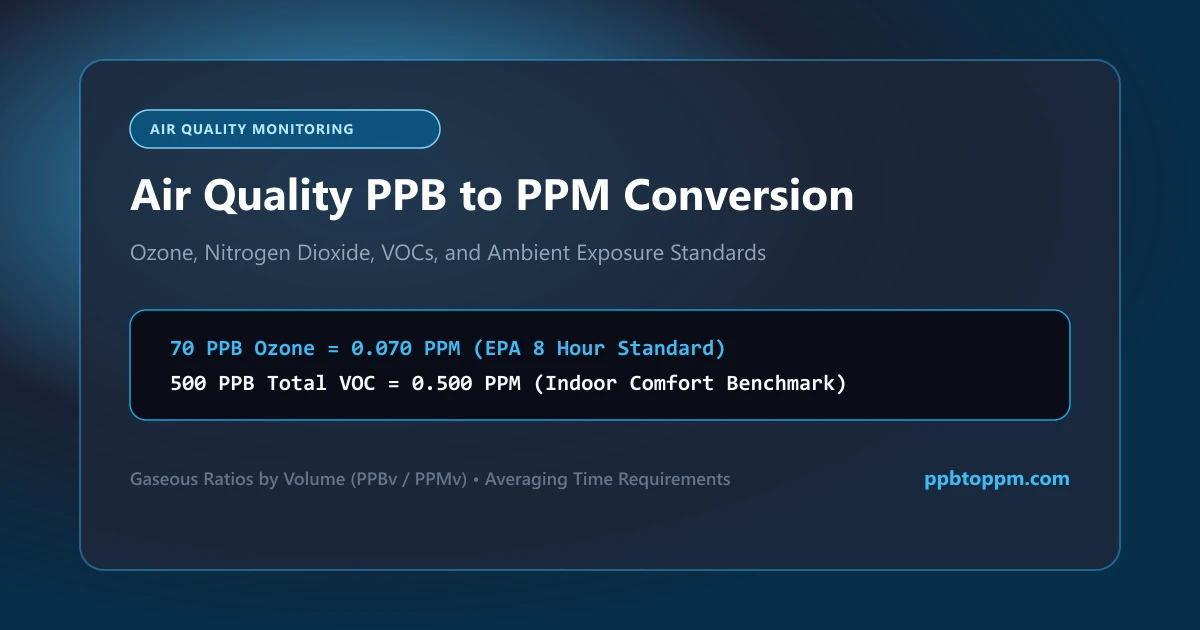
How to Convert PPB to PPM for Air Quality and Trace Pollutants
Convert air pollutant concentrations between PPB and PPM. Guide covers ozone, NO2, VOCs, sensor precision, and regulatory exposure averaging times.
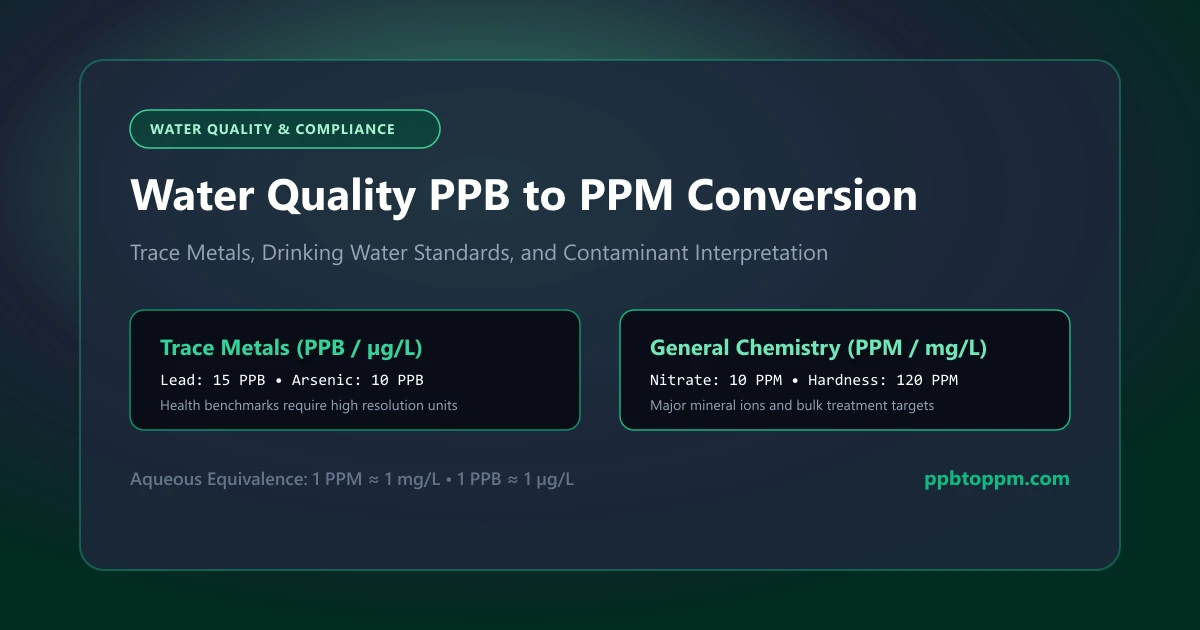
How to Convert PPB to PPM for Water Quality and Contamination Testing
Learn how to convert water contaminant levels between PPB and PPM, covering EPA drinking water limits, trace metals, and compliance reporting.
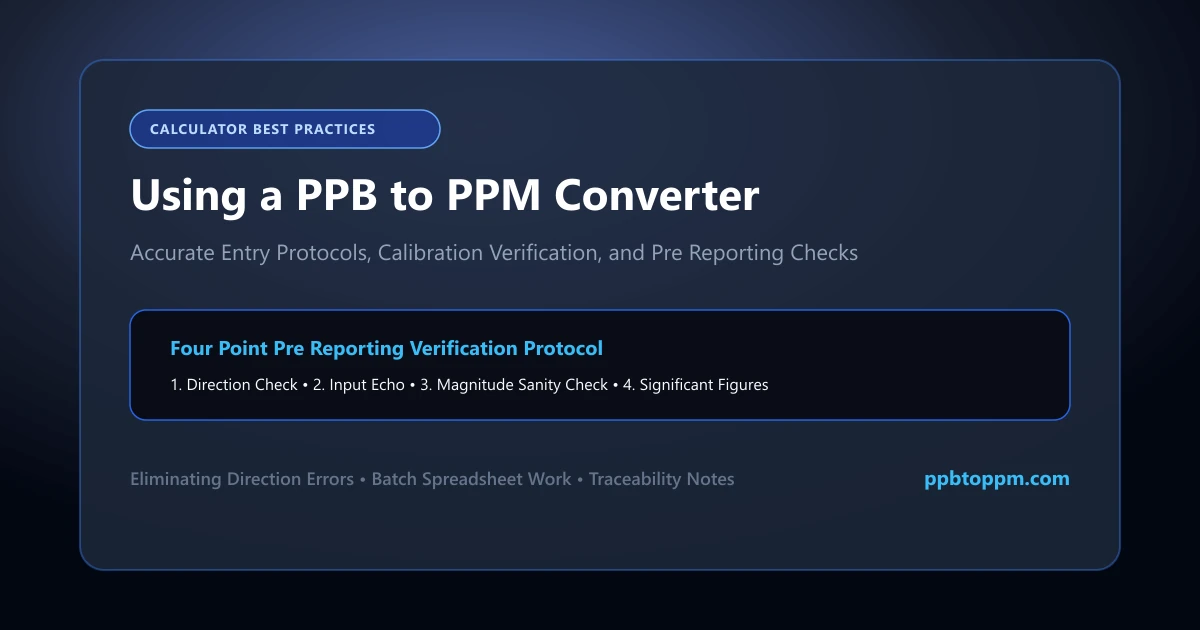
How to Use a PPB to PPM Converter for Accurate Concentration Calculations
Guidelines and verification protocols for using online PPB to PPM converters, avoiding common entry mistakes, and validating report results.
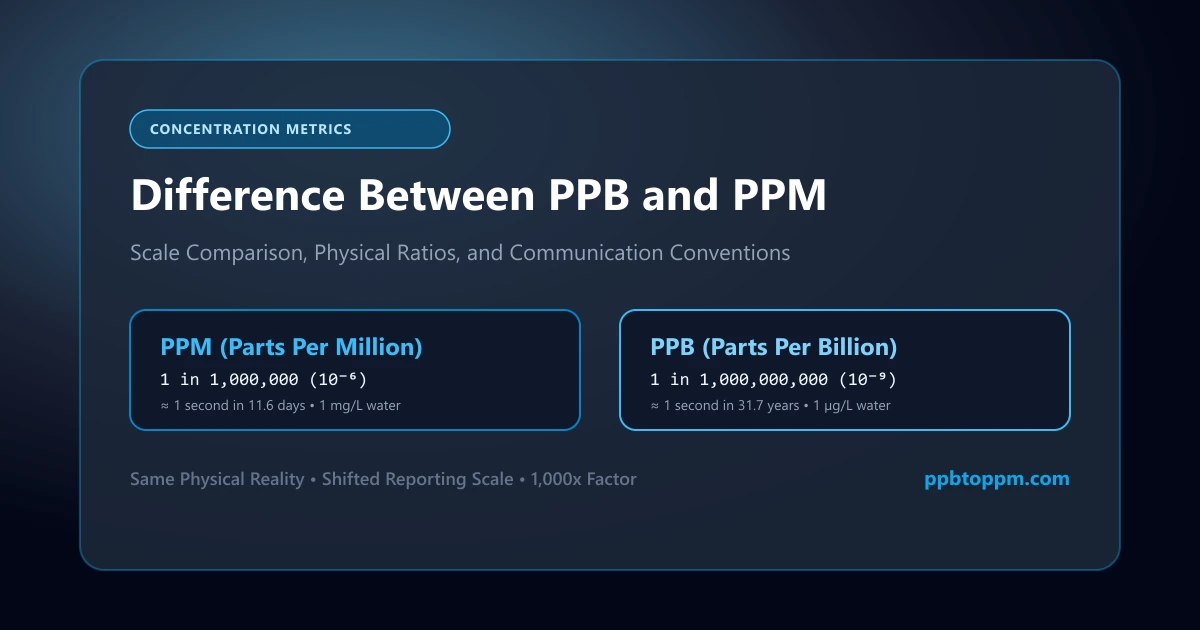
What Is the Difference Between PPB and PPM in Concentration Measurements?
Understand the distinction between PPB and PPM in lab reports and regulatory filings, with intuitive analogies, scale ratios, and reporting rules.