
Whole numbers convert easily, but decimal ppb values raise questions about precision and rounding. This guide covers fractional conversions, explains how many decimal places to retain, and shows how scientific notation keeps very small results readable without sacrificing numerical accuracy.
How do decimal PPB values differ from whole-number values?
Arithmetically they do not differ at all. The same division by 1,000 applies, and the decimal point simply shifts three places left regardless of what precedes it.
The practical difference lies in readability. Converting 5 ppb gives 0.005 ppm, which remains manageable. Converting 0.05 ppb gives 0.00005 ppm, which demands careful zero-counting. Decimal concentration values therefore compound the readability problem that ppb was adopted to solve, making unit choice more important rather than less.
How can fractions of one PPB be converted?
Values below one ppb follow the identical rule. A reading of 0.5 ppb becomes 0.0005 ppm; 0.25 ppb becomes 0.00025 ppm.
| PPB | PPM |
|---|---|
| 0.1 | 0.0001 |
| 0.25 | 0.00025 |
| 0.5 | 0.0005 |
| 0.75 | 0.00075 |
At this magnitude, consider whether ppt would serve better. A fractional ppb figure of 0.5 equals 500 ppt, which reads far more comfortably than either alternative. Many laboratories working with ultra-trace analytes switch units precisely here for exactly this reason.
How should very small decimal concentrations be written?
Three formats compete: plain decimal, scientific notation, or a smaller unit. Each has its place depending on audience and document type.
“If you have to count zeros twice, the format is wrong.”
Plain decimal works down to about 0.001 ppm. Below that, either switch units or adopt exponent notation. For tiny concentrations appearing in tables where readers scan quickly, the smaller unit usually wins, since scientific notation requires a moment of mental processing that plain numbers do not.
How can scientific notation simplify tiny values?
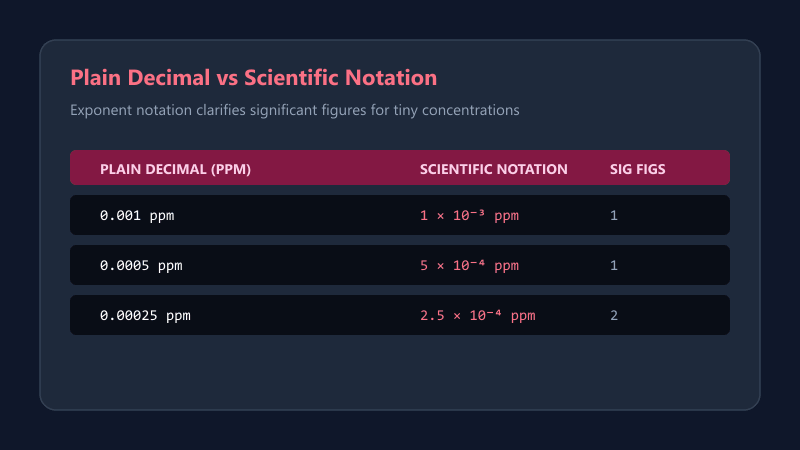
Scientific notation expresses any number as a coefficient multiplied by a power of ten. The value 0.00025 ppm becomes 2.5 × 10⁻⁴ ppm, which conveys magnitude at a glance.
| Decimal | Scientific |
|---|---|
| 0.001 | 1 × 10⁻³ |
| 0.0005 | 5 × 10⁻⁴ |
| 0.00025 | 2.5 × 10⁻⁴ |
| 0.0001 | 1 × 10⁻⁴ |
The format also makes significant figures explicit, which plain decimals obscure. Writing 2.5 × 10⁻⁴ states clearly that two digits are significant. Writing 0.00025 leaves that ambiguous, since trailing and leading zeros carry different meaning depending on convention.
How do you preserve precision during conversion?
Carry every digit through the calculation and round only at the final step. Intermediate rounding introduces drift that compounds across multi-step calculations.
This matters particularly when conversion forms part of a longer chain, such as converting units, applying a dilution factor, then adjusting for recovery. Each premature rounding step adds error. Maintaining full numerical precision until the reported value costs nothing computationally and protects conversion accuracy throughout the workflow.
How many decimal places should the result contain?
Match the significant figures of your input, not the digits your calculator displays. A measurement of 45 ppb carries two significant figures, so 0.045 ppm is correct while 0.0450000 ppm falsely implies seven.
| Input | Sig. figs | Output |
|---|---|---|
| 45 ppb | 2 | 0.045 ppm |
| 45.0 ppb | 3 | 0.0450 ppm |
| 4.5 ppb | 2 | 0.0045 ppm |
Reporting more digits than the measurement supports overstates analytical precision and can mislead readers about method capability. Laboratory quality systems generally specify significant-figure rules, and these should govern the reported figure rather than calculator output.
How can rounding change a converted concentration?
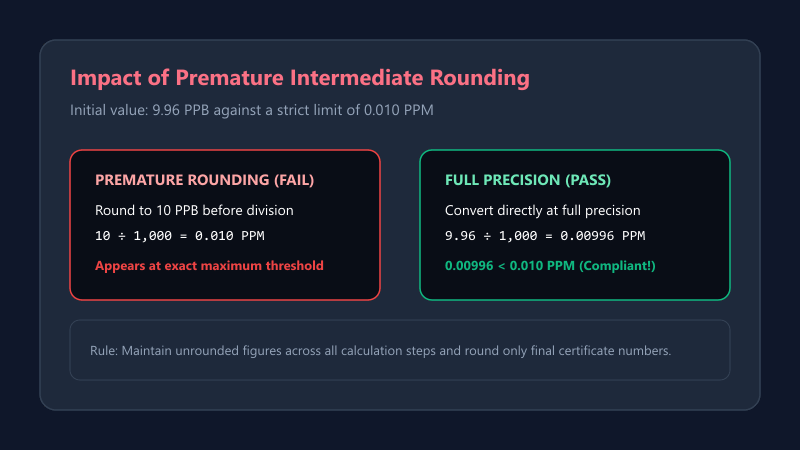
Rounding at the wrong point shifts values in ways that occasionally matter for compliance decisions. A figure of 9.96 ppb rounded to 10 ppb before conversion gives 0.01 ppm, while converting first gives 0.00996 ppm.
Against a limit of 0.01 ppm, those two paths produce opposite compliance conclusions. This is not a hypothetical concern near regulatory thresholds. Standard practice is to convert at full precision and round only the final reported value, applying the organisation’s documented concentration rounding rules at that single point.
How can you verify a result with reverse conversion?
Multiply your ppm figure by 1,000 and confirm it returns the original ppb value. For 0.045 ppm, multiplying gives 45 ppb exactly, confirming the conversion.
With decimals, small discrepancies may appear from earlier rounding. A return value of 44.98 rather than 45 indicates rounding somewhere upstream rather than an error in the conversion itself. For exact conversion work, performing this reverse calculation on every value takes seconds and catches genuine mistakes reliably.
Which calculator settings help avoid rounding errors?
Set the display to maximum decimal places or to scientific notation before starting. Many calculators default to two decimals, which silently truncates small results and produces zero where a real value exists.
In spreadsheets, distinguish display formatting from stored value. A cell may show 0.00 while holding 0.000345 internally, so column width and format settings should reveal full calculation precision during checking. Verify the setting with a known test value, such as confirming that 1 ppb returns 0.001 ppm rather than 0.00.
Case Study: The Truncated Column
A laboratory exported metals data to a client template formatted to three decimal places. Several ppb results below 1 converted to ppm values smaller than 0.001 and displayed as 0.000 in the delivered spreadsheet. The client interpreted these as non-detects and excluded them from a trend analysis. Underlying values ranged from 0.0002 to 0.0008 ppm — real detections, invisible through formatting alone. The laboratory subsequently switched to reporting all trace metals in ppb regardless of magnitude.
Conclusion
You can now convert any decimal ppb to ppm value while preserving precision. Divide by 1,000, carry full digits through, and round only the final reported figure.
Match significant figures to your input and check display settings before trusting any output. A precision check by reverse multiplication confirms every result in seconds.