
Laboratory reports rarely agree on units. One result arrives in parts per billion, the next in parts per million, and comparing them takes a quick calculation. Fortunately the ppb to ppm conversion rests on a single division. This guide explains both units, walks through the formula, and shows how to verify every result you produce.
What does PPB mean in concentration measurements?
PPB stands for parts per billion and describes how much of one substance exists within a billion parts of the total mixture. If a water sample contains 5 ppb of a contaminant, five units of that substance sit among one billion units of water. The ppb measurement therefore expresses a ratio, not an absolute quantity, which is why it works equally well for liquids, gases and solids.
To grasp the scale, imagine a single drop of ink in a swimming pool holding twenty thousand litres. That is roughly the territory of trace concentration work. Because modern instruments detect substances at these levels routinely, laboratory concentration reports lean heavily on ppb for pollutants, dissolved metals and pesticide residues. The unit keeps numbers readable where ppm would produce awkward strings of zeros after the decimal point.
What does PPM mean in concentration measurements?
PPM means parts per million and follows identical logic one thousand steps higher. A ppm measurement of 3 indicates three units of substance within one million units of total mixture. Most drinking-water standards, fertiliser labels and industrial specifications use this concentration scale because the resulting numbers land conveniently between one and a few hundred.
The relationship to everyday units helps too. In dilute water solutions, one ppm corresponds closely to one milligram per litre, since a litre of water weighs roughly one million milligrams. That equivalence makes solution concentration figures easy to translate into laboratory glassware terms. For chemical concentration reporting across regulatory documents, ppm remains the default choice worldwide.
How is the PPB-to-PPM conversion relationship established?
The link between the two units comes straight from their definitions. A billion is exactly one thousand times a million, so one ppm contains precisely one thousand ppb. This fixed conversion factor never varies, regardless of substance, temperature or sample type, because both units describe pure ratios rather than physical amounts.
| Relationship | Value |
|---|---|
| 1 ppm | 1,000 ppb |
| 1 ppb | 0.001 ppm |
That constancy makes unit conversion between the two genuinely trivial. Unlike temperature scales, which require both multiplication and an offset, this concentration conversion needs only one operation. Whether you are handling contaminant concentration in groundwater or trace gases in ambient air, the same thousand applies without adjustment.
Why is 1,000 used in the conversion?
The number 1,000 appears because it represents the gap between a million and a billion. Written out, a million is 10⁶ and a billion is 10⁹. Dividing the larger by the smaller leaves 10³, which equals 1,000 exactly. This is arithmetic, not convention, so the conversion factor carries no uncertainty whatsoever.
“The factor is not an approximation. It falls directly out of the definitions.”
One caution deserves mention. English-speaking countries use the short scale, where a billion equals one thousand million. Some European traditions historically used a long scale, where a billion meant a million million. In analytical measurement contexts the short scale is universal, so ppb always means 10⁻⁹. Still, when reading older or translated documents, confirming the scale prevents a thousandfold error.
How do you convert PPB to PPM manually?
Divide the ppb figure by 1,000. That single step completes the entire concentration formula, and most values can be handled mentally by shifting the decimal point three places to the left. A reading of 450 ppb becomes 0.45 ppm without any calculation at all.
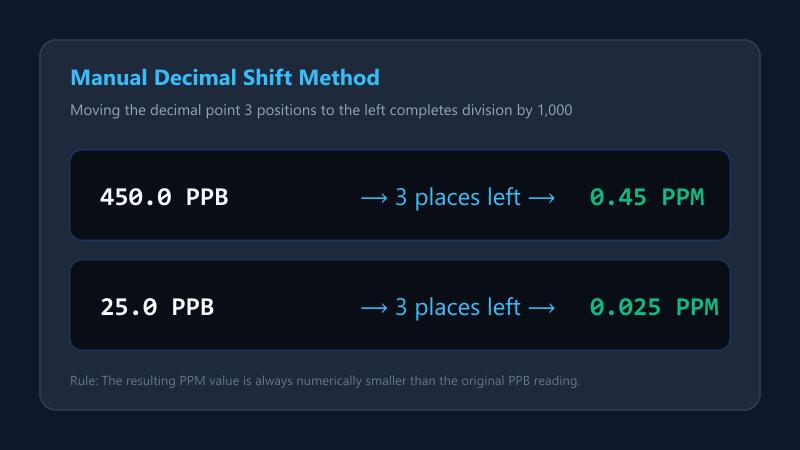
Work through a second example to fix the pattern. A ppb value of 2,500 divided by 1,000 gives 2.5 ppm. A value of 75 gives 0.075 ppm. Notice that the resulting ppm value is always numerically smaller, because ppm is the larger unit. If your answer comes out bigger than your starting figure, you multiplied when you should have divided.
How do you calculate PPB to PPM with a calculator?
Enter the ppb figure, press divide, type 1000, then press equals. Three keystrokes and the ppb to ppm calculation is finished. Some scientific calculators offer exponent entry, in which case multiplying by 10⁻³ achieves the same result with fewer keystrokes.
For longer lists, a spreadsheet handles the work more reliably. Place your ppb figures in one column and apply a division formula in the next, then copy it down the full range. This approach removes transcription errors entirely, which matters when processing dozens of laboratory concentration results from a single sampling round. A dedicated concentration calculator offers the same benefit for one-off checks.
How should decimal PPB values be handled?
Decimals follow exactly the same rule with no special treatment required. A reading of 0.8 ppb divided by 1,000 becomes 0.0008 ppm. A figure of 12.5 ppb becomes 0.0125 ppm. The decimal point simply moves three places left, adding leading zeros where needed.
| PPB | PPM |
|---|---|
| 0.5 | 0.0005 |
| 2.5 | 0.0025 |
| 12.5 | 0.0125 |
Very small results quickly become hard to read, which is precisely why low concentration units like ppb exist in the first place. When a converted figure carries four or more leading zeros, consider whether reporting in ppb would communicate better. Scientific notation offers another route: 0.0008 ppm can be written as 8 × 10⁻⁴ ppm for clearer quantitative measurement documentation.
How can you verify a converted concentration?
Reverse the operation. Multiply your ppm answer by 1,000 and you should land exactly on the original ppb figure. If 0.45 ppm times 1,000 returns 450 ppb, the conversion is confirmed. This check takes seconds and catches every arithmetic slip.
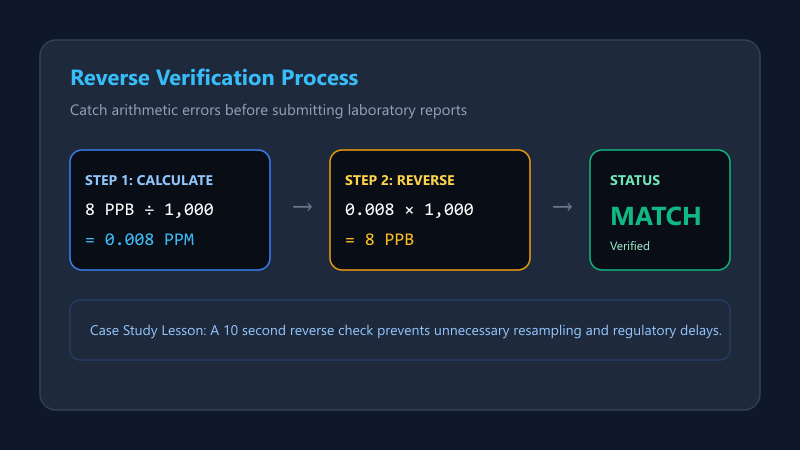
Estimation provides a useful second layer. Your ppm result must always be one thousand times smaller than the ppb input, so the decimal point should sit three places further left. A quick glance at digit positions reveals misplaced decimals faster than recomputing. For critical analytical measurement work, running both checks before reporting is worth the twenty seconds it costs.
What mistakes should be avoided during conversion?
Multiplying instead of dividing tops the list. The error produces a figure one million times too large, which usually looks absurd enough to catch attention, though not always when the original value was already tiny. Always confirm that your ppm value came out smaller.
The second frequent error involves dropping the unit label entirely. A bare number in a water testing report invites misinterpretation, since 0.45 could plausibly be ppm, ppb or mg/L. Third, rounding too early accumulates drift across a series of calculations. Keep full precision throughout and round only the final reported figure, following your laboratory’s concentration reporting conventions.
Case Study: The Duplicated Sample
An environmental technician received two reports on the same groundwater sample from different laboratories. The first listed arsenic at 8 ppb, the second at 0.008 ppm. A colleague flagged them as inconsistent and requested a resample. In fact both figures were identical, expressed in different units. Converting 8 ppb by dividing by 1,000 gives exactly 0.008 ppm. The unnecessary resample cost the project three weeks and several hundred euros, all because nobody performed a ten-second division before raising the alarm.
Conclusion
You can now handle any ppb to ppm formula application with confidence. Divide by 1,000, or shift the decimal point three places to the left, and the conversion is complete.
Verify every result by multiplying back, and keep unit labels attached at all times. The arithmetic itself is straightforward; the discipline around it is what keeps environmental analysis reports trustworthy. For regulatory submissions, always confirm requirements with the relevant authority.